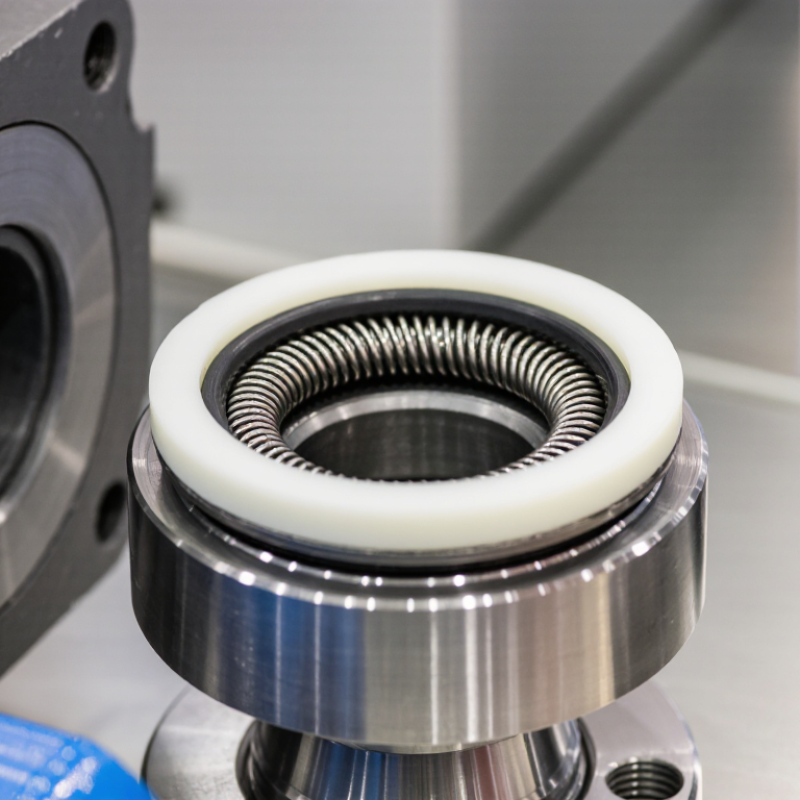
Global buyers face a difficult choice when selecting a Ptfe Elgiloy Lip Seal for demanding equipment. Catalog descriptions rarely reveal the full operating risk.
Dr. Robert M. Flitney, a recognized sealing specialist and author of Seals and Sealing Handbook, states, “Seal design begins with the operating conditions, not the catalog page.” This principle remains practical. Buyers should examine temperature, pressure, shaft speed, media compatibility, and installation conditions before comparing prices.
A reliable evaluation starts with the sealing environment. PTFE offers low friction and strong chemical resistance. Elgiloy provides resilient spring performance in corrosive or high-temperature service. Together, they can support pumps, valves, actuators, and rotating machinery. However, material names alone do not guarantee performance.
Check the compound grade.
Review the lip geometry carefully. A seal designed for a polished shaft may fail quickly on a rough or damaged surface. Confirm shaft diameter, runout, hardness, and surface finish. Ask suppliers for dimensional tolerances, batch traceability, temperature limits, and pressure data.
Global purchasing also requires practical verification. Request samples, technical drawings, inspection reports, and application references. Independent testing may expose leakage that a product sheet overlooks. This step costs time, but replacement costs more.
Some buyers focus too heavily on unit price. That approach can be shortsighted. A cheaper seal may increase downtime, contamination, and maintenance labor. Even experienced engineers can miss installation errors or unusual chemical exposure. Therefore, selection should combine supplier expertise, documented testing, and field experience.
The right Ptfe Elgiloy Lip Seal is not simply the most expensive option. It is the seal matched carefully to real operating conditions. That match deserves evidence.
PTFE lip seals with cobalt-based alloy energizers are built for demanding sealing environments. Their structure combines a flexible PTFE sealing lip, a metal spring, and a protective outer profile. The lip contacts the rotating shaft with controlled pressure. The spring maintains contact as the material wears or thermal conditions change. Fit matters.
PTFE offers low friction, chemical resistance, and useful performance across a wide temperature range. Its formulation may include carbon, glass fiber, graphite, or other fillers. Each filler changes wear resistance, stiffness, and shaft compatibility. The cobalt-based alloy energizer resists corrosion and keeps its spring force under heat. Buyers should verify alloy composition, operating temperature, pressure, shaft speed, and fluid exposure before selecting a seal.
During operation, a thin fluid film separates the lip from the shaft. This film limits friction while the lip blocks leakage. Excessive pressure can deform the lip, while a dry shaft can create rapid wear. Installation quality matters as much as material selection. A scratched shaft, sharp keyway, or twisted spring can cause early failure. In field work, catalog ratings sometimes seem reliable but do not match real motion, vibration, or contamination. Measure the actual assembly. Test under representative conditions.
PTFE is commonly selected for its low friction, chemical resistance, and high continuous-use temperature. A corrosion-resistant cobalt-based spring alloy can maintain lip contact force in demanding environments. The temperature values below are typical upper continuous-use ratings for common seal-jacket materials; actual limits depend on pressure, shaft speed, media, compound formulation, and hardware design.
How to Choose PTFE Elgiloy Lip Seals for Global Buyers?
Identify application conditions before comparing seal prices. Record shaft speed, pressure, temperature, media, and motion type. A rotating shaft at 3,000 rpm needs different lip geometry than a slow hydraulic actuator. Check start-up conditions too. Dry running can damage the sealing edge within seconds.
PTFE offers low friction and strong chemical resistance, while the cobalt-based spring energizer supports recovery under thermal cycling. According to Grand View Research’s 2024 industrial seals report, demand is rising with automation and equipment efficiency requirements. That trend increases attention on leakage control and service life. The U.S. Department of Energy also reports that friction losses can represent a meaningful share of industrial energy use. However, material selection alone cannot solve poor shaft finish, misalignment, or excessive pressure. I have seen technically correct seals fail because the installation tool scratched the lip. That mistake is easy to overlook.
Tips: Build a condition sheet before requesting quotations. Include shaft diameter, surface roughness, hardness, pressure peaks, temperature range, and fluid composition. Ask for test data under your actual speed and media, not only catalog limits. ISO 6194 guidance can help evaluate rotary shaft seal dimensions and performance. Leave room for uncertainty. Real equipment often experiences vibration, contaminated fluid, and short dry starts. A prototype test is still wiser than a confident guess.
| Selection Dimension | Application Condition to Confirm | Typical Engineering Data or Range | Recommended Seal Requirement | Buyer Verification Point |
|---|---|---|---|---|
| Seal Material | Chemical exposure, temperature, pressure, and required service life | PTFE offers very broad chemical resistance and a low coefficient of friction; the exact performance depends on grade, filler, temperature, and mating surface | Select virgin or filled PTFE according to wear, extrusion, friction, and media requirements | Request the compound formulation, temperature limits, pressure limits, and compatibility data for the actual medium |
| Spring Energizer | Corrosive gas, salt water, cleaning chemicals, sterilization, and cyclic loading | Cobalt-chromium alloy spring materials are commonly selected where high corrosion resistance, spring force retention, and elevated-temperature stability are required | Use a corrosion-resistant energizer with sufficient preload for the pressure and temperature range | Confirm alloy designation, heat treatment, surface condition, and resistance to the specific process fluid |
| Operating Temperature | Minimum and maximum continuous temperature, short-term excursions, and thermal cycling | Many PTFE lip-seal compounds are used across approximately −60 °C to +260 °C, but the usable range varies by compound, pressure, speed, and energizer | Rate the seal for continuous temperature and separately check intermittent peak temperature | Obtain temperature derating data rather than relying only on the polymer’s nominal temperature limit |
| System Pressure | Pressure level, pressure direction, pressure spikes, and static or dynamic operation | Pressure capability depends strongly on seal geometry, radial clearance, extrusion gap, temperature, and speed; unsupported PTFE lips are more sensitive to extrusion | Use anti-extrusion support or a pressure-optimized profile when pressure or clearance is high | Provide maximum differential pressure, pressure cycling frequency, and worst-case extrusion gap |
| Shaft or Rod Speed | Rotational speed, reciprocating speed, stroke length, acceleration, and duty cycle | PTFE seals generally support higher sliding speeds than many elastomeric seals, but heat generation is governed by speed, load, lubrication, and surface finish | Choose a low-friction compound and verify the pressure-velocity limit for dynamic service | State rotational speed in rpm or sliding speed in m/s, together with pressure and operating temperature |
| Pressure-Velocity Load | Combined pressure and sliding motion during normal and peak operation | PV performance is compound-specific; increasing pressure, speed, or temperature can increase frictional heat and accelerate wear | Compare the actual duty point with tested PV limits and include a safety margin | Ask for test conditions, counterface material, lubrication state, and allowable leakage criteria |
| Chemical Compatibility | Fluid composition, concentration, contaminants, additives, and cleaning agents | PTFE is resistant to most acids, bases, hydrocarbons, solvents, and gases; molten alkali metals, elemental fluorine, and some high-temperature reactive agents require special review | Evaluate both the PTFE compound and the metallic energizer because the spring may be less resistant than the polymer | Submit the complete fluid list, concentration, pressure, temperature, and exposure duration for compatibility review |
| Shaft or Counterface Material | Material hardness, coating, corrosion resistance, and surface integrity | Common counterfaces include hardened steel, stainless steel, ceramics, and coated surfaces; the correct pairing depends on speed, load, and lubrication | Use a hard, smooth, defect-free counterface compatible with the selected PTFE compound | Confirm hardness, coating thickness, porosity, runout, scratches, and lead or spiral marks |
| Surface Finish | Dynamic sealing surface roughness and direction of machining marks | A typical dynamic sealing surface may require approximately Ra 0.1–0.4 µm, subject to seal design, speed, lubrication, and manufacturer validation | Avoid rough, porous, or directional surfaces that can increase wear or pump fluid past the lip | Specify the measurement method, roughness parameters, lay direction, and allowable surface defects |
| Radial Clearance and Extrusion Gap | Housing-to-shaft clearance, pressure direction, temperature expansion, and tolerance stack-up | Larger extrusion gaps increase the risk of PTFE lip deformation, especially at high pressure and temperature | Reduce clearance or add a support feature when pressure, temperature, or dimensional tolerance increases the extrusion risk | Provide minimum and maximum clearances at assembly and at operating temperature |
| Installation Geometry | Groove dimensions, lead-in chamfers, assembly direction, and available installation tools | PTFE seals can be damaged by sharp edges, splines, keyways, or forced stretching beyond the seal design | Specify controlled lead-in geometry, edge radii, and installation protection for the lip and energizer | Request dimensional drawings, groove tolerances, installation instructions, and inspection gauges |
| Leakage and Friction Target | Allowable leakage, breakaway torque, running torque, noise, and energy consumption | A tighter lip can reduce leakage but may increase friction and heat; a lighter lip can reduce friction but may require better surface control | Balance sealing force, friction, wear, and acceptable leakage for the actual duty cycle | Define measurable leakage and friction limits, test duration, temperature, speed, and pressure |
| Lubrication and Dry Running | Process fluid lubricity, external lubrication, start-stop cycles, and accidental dry running | PTFE has low friction, but dry running can still generate heat and wear; filled grades may improve wear resistance | Select a compound validated for lubricated, marginally lubricated, or dry-running conditions | Confirm lubricant type, compatibility, replenishment method, start-up condition, and maximum dry-running duration |
| Thermal Expansion and Compression Effects | Temperature variation, trapped volume, seal interference, and dimensional changes | PTFE has relatively high thermal expansion and can exhibit creep or cold flow under sustained load | Use a groove and interference design that maintains sealing force without excessive friction or deformation | Review dimensional tolerances at minimum and maximum operating temperatures |
| Cyclic and Pulsating Service | Pressure frequency, direction reversal, reciprocating motion, vibration, and shock loading | Repeated cycling can cause lip fatigue, spring movement, wear, and transient leakage if the profile is not designed for reversal | Select a profile and energizer configuration designed for the actual motion and pressure cycle | Provide cycle count, frequency, pressure waveform, stroke or rotation direction, and target service life |
| Cleanliness and Regulatory Needs | Particle sensitivity, contamination limits, sterilization, vacuum service, and export requirements | Clean applications may require controlled manufacturing, cleaning, packaging, and traceability; not every PTFE compound is suitable for every regulated process | Specify cleanliness level, extractables limits, documentation, and required material declarations | Confirm batch traceability, inspection records, packaging method, certificates, and applicable compliance documents |
| Quality and Validation | Critical dimensions, incoming inspection, sample approval, and production consistency | Seal performance is sensitive to lip geometry, spring force, material condition, and surface defects | Use defined drawings, inspection criteria, functional testing, and change-control requirements | Request dimensional reports, material certificates, spring-load data, sample test results, and notification of design or material changes |

How to Choose PTFE Elgiloy Lip Seals for Global Buyers?
PTFE and Elgiloy must match the actual media, temperature, and pressure. PTFE offers low friction and strong chemical resistance. Typical service guidance places PTFE near -200°C to 260°C, but compression, speed, and loading change the result. ASM Handbook, Volume 13B, highlights that chemical resistance alone cannot predict sealing life. A neat material chart can mislead.
Elgiloy energizers help maintain spring force during thermal cycling and corrosive exposure. This matters in pumps, valves, and rotating equipment. Check the media first: acids, solvents, steam, and abrasive particles may require different PTFE compounds. At high pressure, inspect the extrusion gap and housing finish. API 6A qualification practice treats pressure capability as an assembly result, not a seal-material number. NIST material-property data also shows why temperature-dependent expansion needs attention. Do not assume the widest temperature range is safest.
Tips: Request media concentration, pressure spikes, shaft speed, and surface roughness from the equipment user. Select the seal after reviewing real duty cycles, not only catalog limits. A static seal may survive a test while a rotating seal fails quickly. That distinction is easy to miss. Validate with a pressure-and-temperature cycle test, then inspect lip wear and spring recovery. I would also document any uncertain operating value instead of hiding it.
For global buyers, seal selection starts with dimensions, not catalog photos. Record shaft diameter, housing bore, groove width, radial clearance, and available axial space. Use ISO 286-2 tolerance principles when checking shaft and bore fits. A small mismatch can increase leakage or create excessive lip pressure. Measure the actual hardware, because drawings are sometimes optimistic.
Lip design should match pressure, speed, temperature, and media. A single lip suits many low-pressure rotary duties, while pressure-assisted or dual-lip designs offer stronger separation. PTFE reduces friction, but it still needs a controlled surface finish and suitable hardness. Corrosion-resistant cobalt-alloy energizers can support demanding chemical environments. They are not automatically correct for every medium. Review compatibility data, especially with solvents and high-temperature fluids. The U.S. Department of Energy’s compressed-air guidance reports that leaks can waste 20–30% of compressor output, showing why small sealing defects deserve attention.
Installation configuration matters just as much. Confirm whether the seal is installed from the pressure side, over a shaft shoulder, or inside a removable cartridge. Protect the lip with a tapered sleeve, lubricate only when permitted, and avoid stretching the seal across sharp edges. Keep the energizer seated evenly. Field practice often reveals the uncomfortable detail: many “seal failures” begin during assembly. I have seen clean components installed with misaligned tools. That mistake is easy to repeat. Test leakage, friction, and run-in behavior at the real operating temperature, not only at room temperature.
Choosing PTFE lip seals with cobalt-based alloy energizers requires more than comparing unit prices. Global buyers should assess media compatibility, temperature range, shaft speed, pressure, and installation conditions. I usually request a technical drawing before discussing quotations. A seal that fits the housing may still fail against a rough or misaligned shaft.
Supplier evaluation should include production experience, inspection equipment, and documented quality controls. Check whether the supplier follows recognized quality systems, such as ISO 9001, and ask for dimensional reports, material certificates, and lot traceability. Confirm the PTFE grade, filler content, spring alloy, and operating limits. Samples matter. Paperwork alone can hide inconsistent molding or poor lip geometry.
Documentation must match the destination market. Request a certificate of conformity, inspection records, packing details, and relevant chemical compliance declarations. Delivery terms deserve equal attention. Compare lead time, minimum order quantities, export packaging, customs documents, and Incoterms. Clarify who handles freight damage and delayed clearance. I have seen technically excellent seals arrive late because responsibilities were vague. That is an avoidable weakness. A trial order can expose packaging problems, dimensional variation, and communication gaps before production quantities are released. Supplier claims should be checked against actual samples and measurable test results.
To learn more about any of the products and services provided by Abbott Ball Company, Inc., simply complete the form below.