
Choosing the right Chicken Injector can influence flavor consistency, production speed, and cleaning time. It is not merely a small kitchen tool. In a busy food business, it becomes part of the quality system. A weak plunger can leave dry pockets inside a chicken breast. A poorly sealed needle can spill brine across the preparation table.
Industry demand supports careful equipment selection. The USDA Economic Research Service continues to identify chicken as a major protein category in U.S. food availability data. The FAO Food Outlook also reports strong global demand for poultry products because of affordability and efficient production. These trends create pressure for repeatable processing. Every batch should taste similar, even during a Friday rush.
Meathead Goldwyn, founder of AmazingRibs.com, writes, “Injecting is a great way to get flavor deep into meat.” That practical point matters. Flavor must travel beyond the surface. Buyers should compare reservoir capacity, pressure control, needle diameter, seal quality, and food-contact materials. Stainless steel is usually easier to inspect. Smooth components also reduce residue after washing. Look for tools that can handle thick marinades without clogging.
Do not trust marketing alone. Test the injector with your actual marinade. Check whether herbs block the needle. Measure output across ten chicken pieces. Record leakage and cleaning time. A cheaper model may appear efficient. It may not be. Small inconsistencies become expensive when multiplied across hundreds of portions. The best Chicken Injector is the one your staff can operate safely, clean completely, and use consistently. Even that choice deserves review.
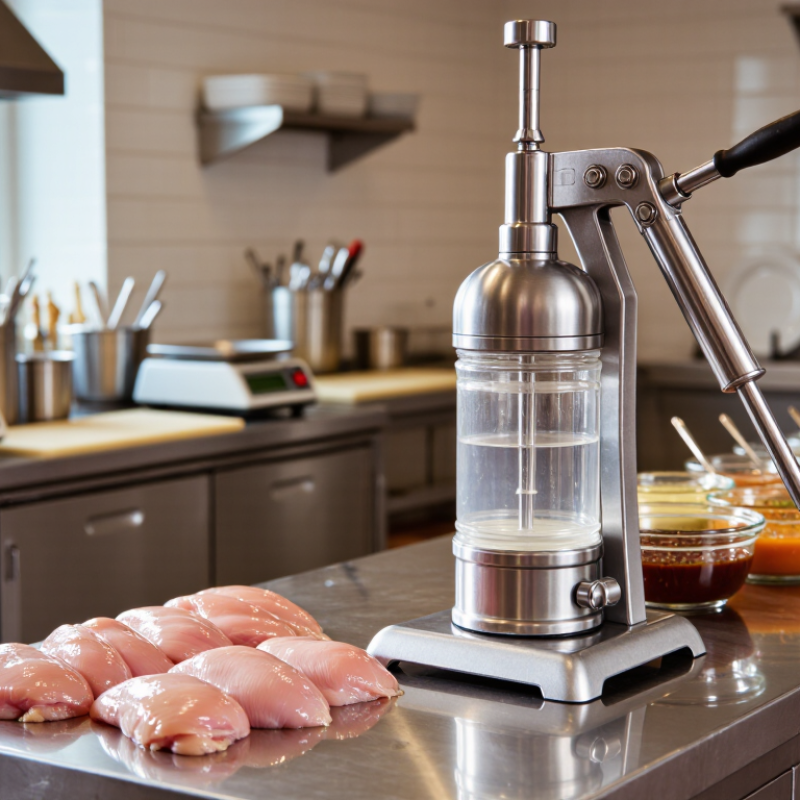
How to Choose the Best Chicken Injector for Your Business?
Define Your Business’s Chicken Injection Needs
Choosing a chicken injector should begin with your daily production reality. A small restaurant may inject 30 kilograms of poultry each morning. A processing facility may handle several tons before lunch. These operations need different equipment, even when the recipe looks similar.
Record your chicken sizes, marinade thickness, injection volume, and production speed. A manual injector can provide control for varied batches and seasonal menus. An automatic system may improve consistency during high-volume production. Needle spacing also matters. Closely spaced needles can distribute liquid across broad chicken breasts. Fewer needles may suit smaller cuts or delicate products. Consider cleaning time, worker training, and available floor space. These details often influence efficiency more than advertised capacity.
Tips: Test the injector with your actual marinade. Thick mixtures may clog narrow needles. Measure yield before and after injection. Check whether the meat stays moist without leaking excess liquid. Ask operators to inspect the machine after a full shift, not only during a demonstration. A simple checklist can reveal awkward controls or difficult-to-reach surfaces. Do not choose based on capacity alone. I have seen equipment selected for future growth while current staff struggled with basic cleaning. That assumption can become expensive. A practical trial, clear maintenance plan, and honest production forecast create a more reliable decision.
Select an injector by matching its practical capacity to your daily production volume. Smaller operations may prioritize compact equipment for batches below 500 chickens per day, while medium and high-volume businesses generally need higher throughput, larger brine capacity, and more injection needles to maintain consistent processing during an eight-hour shift.
The chart uses common production-planning profiles expressed as chickens processed per day and estimated injection capacity required per hour.
In a busy poultry kitchen, injector choice affects yield, texture, cleaning time, and repeatability.
USDA Economic Research Service food availability data place recent U.S. broiler consumption near 100 pounds per person annually. Small process losses can multiply quickly.
Compare the injector type with your batch size. Single-needle models suit small batches and manual brining. Multi-needle units cover wider surfaces faster, but they require steady spacing and pressure.
Continuous injectors fit high-throughput lines, where conveyor speed, pump control, and brine temperature must remain consistent. That capacity may be wasteful for a seasonal operation.
Key features deserve a side-by-side check.
Look for adjustable pressure, needle depth, removable contact parts, and a calibrated brine tank.
Food safety matters more than a polished control panel. USDA FSIS sanitation guidance stresses hygienic equipment design and effective cleaning to reduce cross-contamination risks.
FAO’s 2023 livestock outlook identifies poultry as a major growth area in global meat supply. That increases the value of durable components and reliable output.
Test pickup weight, purge loss, and cooking yield during a short trial. Looks can mislead.
It is easy to treat needle count as the deciding metric, but that assumption needs revisiting. Compare results after chilling, not only immediately after injection.
Some teams skip this check. They often regret it.
Choosing a chicken injector for business requires more than counting needles. Capacity must match your daily production rhythm, not your best hour. The 2024 USDA Foreign Agricultural Service report forecasts global broiler production above 100 million metric tons, increasing pressure on processors to deliver consistent output. Compare birds per hour, brine-tank volume, and loading time. A machine that runs quickly but needs frequent refilling may reduce real productivity.
Precision protects product quality and profit. Check injection accuracy, pressure stability, needle spacing, and pickup control. Small variations can create dry areas, weak flavor, or excessive purge inside the package. The USDA Food Safety and Inspection Service emphasizes process control and accurate recordkeeping for meat and poultry operations. Choose equipment that supports repeatable settings and simple verification. Digital controls help, but they do not replace trained operators.
Tips: Test the injector with your actual cuts, brine viscosity, and target pickup percentage. Measure output during a full shift. Watch the first and last batches. Also inspect dismantling time, sanitation access, and water consumption. These details affect operating efficiency more than brochure speed. I would not trust a capacity claim without observing changeovers. Real production is rarely perfect. A slightly slower injector may perform better when cleaning, loading, and adjustment time are included. USDA data can guide planning, but your own trial records should make the final decision.
Choosing the best chicken injector for your business begins with materials, not marketing claims. Food-contact parts should resist corrosion, cracking, and chemical damage. The FDA Food Code 2022 describes suitable surfaces as smooth, durable, nonabsorbent, and easily cleanable. Stainless steel needles and food-grade polymer chambers are practical choices. However, “food-grade” alone is not enough. Request material declarations and test records from the supplier.
Safety standards deserve equal attention. The World Health Organization estimates that contaminated food causes 600 million illnesses and 420,000 deaths worldwide each year. That figure makes small equipment decisions less small. Select an injector with secure needle fittings, controlled pressure, and guards against accidental punctures. Check whether its design supports local workplace and food-contact requirements. A certificate can help, but it does not replace an on-site risk assessment.
Cleaning is where many operations become inconsistent. Choose a model that comes apart quickly, without hidden channels or difficult seals. FDA Food Code guidance supports cleaning and sanitizing food-contact equipment at suitable intervals, especially when residue can accumulate. Use a written schedule, measured sanitizer concentration, clean water, and complete air-drying. Inspect the needle under bright light. Tiny protein deposits are easy to miss. In practice, a cheaper injector may process more trays per hour, yet cleaning can take twice as long. I would measure total labor, not purchase price. No checklist catches every failure. Recheck the process after busy production days.
| Injector Type | Recommended Business Use | Product-Contact Materials | Typical Needle Configuration | Typical Brine Capacity | Food-Safety Requirements to Verify | Cleaning Requirements | Main Advantages | Important Limitations |
|---|---|---|---|---|---|---|---|---|
| Manual Single-Needle Injector | Small restaurants, butcher shops, test kitchens, and low-volume production | Food-grade stainless steel needle; food-contact plastic or stainless-steel reservoir and plunger | 1 needle; commonly 2–4 mm needle diameter | Approximately 30–100 ml per fill | Confirm food-contact suitability, corrosion resistance, secure needle attachment, and absence of inaccessible dead spaces | Disassemble after each use; wash with warm water and food-safe detergent, rinse, sanitize, air-dry, and store covered | Low purchase cost, easy control, minimal setup, and simple maintenance | Slow output and less uniform distribution for large batches |
| Manual Multi-Needle Injector | Small-to-medium processors requiring better coverage without compressed air | Stainless steel needles and manifold; food-grade tubing and reservoir components | 3–6 needles; interchangeable needle sizes are preferable | Approximately 100–500 ml per fill | Check that all fluid-contact parts are food-grade, removable, smooth, and resistant to brine corrosion | Remove needles, manifold, tubing, and reservoir; clean and sanitize each part separately after every production cycle | Improved coverage and higher output than a single-needle model | More parts to clean; needle blockage can reduce injection consistency |
| Pneumatic Multi-Needle Injector | Medium-to-high volume poultry processing with an existing compressed-air system | Stainless steel product-contact parts; food-grade seals, hoses, and air-line components suitable for washdown areas | Multiple needles, commonly 8–32 depending on machine size | Approximately 1–10 liters in the product reservoir | Verify pressure controls, guarding, emergency shutoff, food-contact documentation, and separation between compressed air and product | Use the validated cleaning procedure; flush product lines, remove needle assemblies, sanitize, inspect seals, and keep air fittings dry | Fast operation, repeatable injection pressure, and better productivity for continuous work | Higher purchase and maintenance costs; requires trained operators and suitable air supply |
| Electric Pump Injector | Medium-to-high volume operations needing adjustable flow and consistent dosing | Stainless steel pump and needles; food-grade hoses, gaskets, and polymer components | Single or multiple needles; configuration depends on pump capacity | Approximately 2–20 liters in the reservoir | Verify electrical protection, washdown rating, grounding, food-contact compliance, and protection against accidental startup | Disconnect power before cleaning; drain and flush the pump, dismantle product-contact parts, sanitize, and prevent water from entering electrical controls | Adjustable flow, consistent dosing, and no separate compressor required | Electrical components require careful washdown procedures and scheduled inspection |
| Continuous Conveyor Injector | Large processors handling standardized chicken portions at high throughput | Stainless steel frame and product-contact assemblies; food-grade seals and conveyor components | Multiple needle banks with adjustable height and spacing | Typically 10–50 liters or more, depending on line design | Verify guarding, interlocks, emergency stops, hygienic design, drainage, operator access, and documented hazard controls | Requires a documented sanitation program, full line disassembly where designed, validated chemical concentration, rinse control, and sanitation verification | Highest throughput, consistent coverage, and integration with automated production lines | High capital cost, larger footprint, and greater training and sanitation requirements |
Choosing a chicken injector starts with your workflow, not the lowest price. OECD-FAO Agricultural Outlook 2024-2033 projects poultry will provide about 41% of additional global meat consumption through 2033. That growth makes repeatable marination increasingly important. A small shop may need a manual, single-needle injector for occasional batches. A high-volume processor needs multiple needles, adjustable pressure, and faster loading.
Match capacity to real production. USDA National Agricultural Statistics Service reported more than 9 billion broilers slaughtered in the United States in 2023. Your operation may handle only a fraction of that volume. Measure kilograms per hour, average piece size, brine viscosity, and operator changeover time. A machine that injects quickly can still waste money if cleaning takes forty minutes after every shift. Ask for measurable injection consistency, not impressive marketing language.
Budget for the complete workflow. Include needles, seals, filters, sanitation tools, spare parts, electricity, and staff training. Stainless construction and tool-free access often cost more initially, but they can reduce downtime. USDA FSIS sanitation guidance supports equipment designs that are accessible for cleaning and inspection. Test the injector with your actual chicken cuts and marinade; water trials can hide clogging problems. My own preference would be moderate speed with stable dosing, though that may be too cautious for a growing line. Cheap equipment is not always economical. Neither is buying excess capacity.
To learn more about any of the products and services provided by Abbott Ball Company, Inc., simply complete the form below.