Discover the Key Properties of 316 Stainless Steel for 2025 Applications
As we look ahead to the applications of materials in 2025, understanding the unique properties of 316 stainless steel becomes increasingly essential. Renowned for its exceptional corrosion resistance, high strength, and remarkable durability, 316 stainless steel is favored across a diverse range of industries, from marine environments to food processing and chemical manufacturing. The distinct 316 stainless steel properties, such as its resistance to pitting and crevice corrosion, make it particularly suitable for use in harsh environments where other metals might fail.
In this exploration of 316 stainless steel properties, we will delve into the key attributes that render this alloy a reliable choice for engineers and designers alike. Not only does its ability to withstand extreme temperatures and resist oxidation set it apart, but its versatility also allows for innovative applications in cutting-edge technologies. As we anticipate the challenges and requirements of future industries, knowing the essential characteristics of 316 stainless steel will be invaluable for making informed material choices that ensure reliability and performance.
Key Characteristics of 316 Stainless Steel for Modern Applications
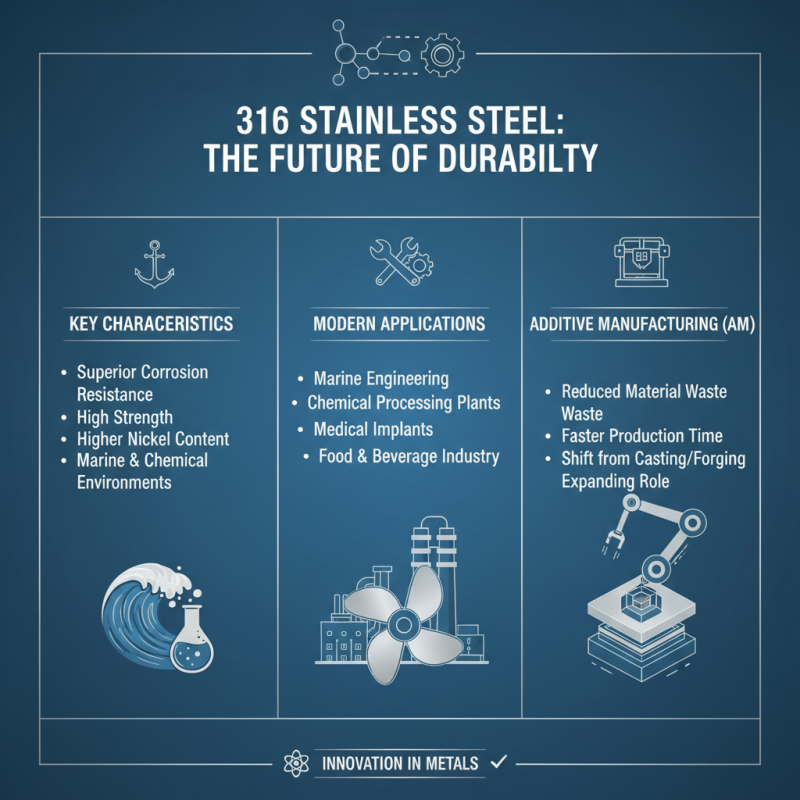
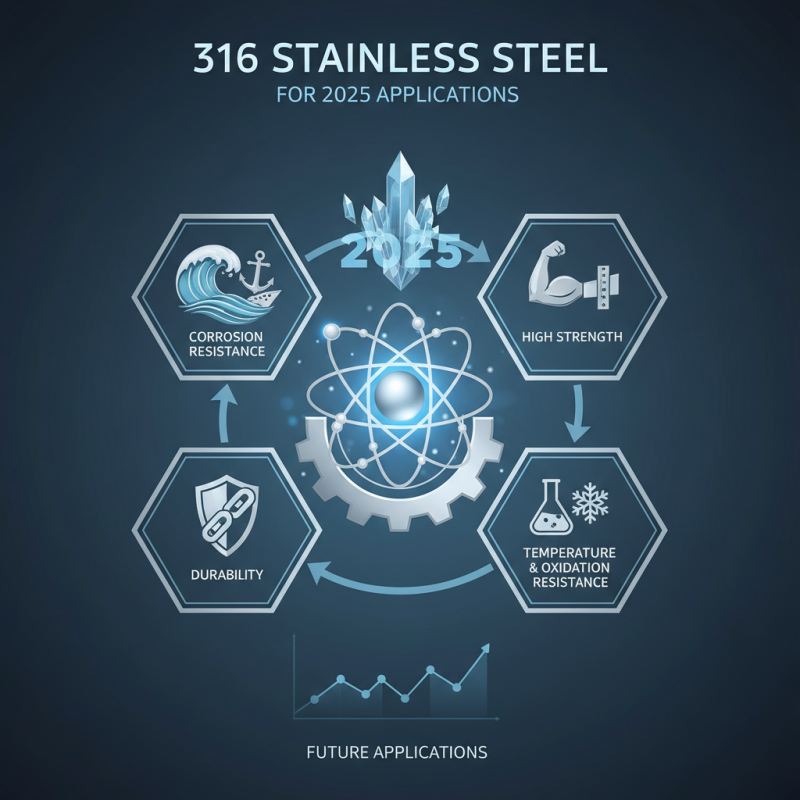
316 stainless steel is renowned for its excellent corrosion resistance and high strength, making it an ideal choice for various modern applications. Its key characteristics, including a higher nickel content compared to other stainless steel types, provides remarkable durability, particularly in marine environments and chemical processing. As industries increasingly adopt additive manufacturing (AM) techniques, the role of 316 stainless steel is set to expand. AM reduces material waste and production time, presenting a shift from traditional methods like casting and forging.
Tips: When selecting materials for additive manufacturing, consider the specific environment the final product will encounter. 316 stainless steel is particularly suitable for applications exposed to harsh conditions, such as offshore oil rigs and pharmaceutical production facilities.
Furthermore, the global market for vinyl ester resins is projected to reach $2.18 billion by 2025, signaling robust growth in composite materials' applications that might complement the usage of 316 stainless steel. With the compound annual growth rate standing at 6.5%, it underlines the importance of integrating advanced materials into innovative manufacturing processes. This trend reflects a broader shift towards optimizing material performance across industries.
Corrosion Resistance: The Advantage of 316 Stainless Steel
316 stainless steel is widely recognized for its exceptional corrosion resistance, making it a preferred choice for various applications in 2025. This austenitic alloy, which contains molybdenum, is particularly effective against chloride-induced corrosion, which is a common challenge in marine environments and in industries such as chemical processing, pharmaceuticals, and food production. The presence of molybdenum enhances the material's ability to withstand pitting and crevice corrosion, allowing for longer service life and reduced maintenance costs.
This remarkable property is crucial for industries where exposure to harsh conditions is inevitable. For instance, in coastal regions where salt spray is prevalent, 316 stainless steel maintains its integrity, reducing the risk of failure that could compromise safety and functionality.
Furthermore, the alloy's resistance to oxidation at elevated temperatures ensures that it remains reliable in applications involving high heat. As industries continue to seek durable and maintenance-free materials, the corrosion resistance of 316 stainless steel positions it as a valuable material for future applications, ensuring operational efficiency and longevity in challenging environments.
Mechanical Properties and Performance in Various Environments
316 stainless steel, known for its excellent mechanical properties, is a top choice for various applications expected in 2025. This alloy exhibits an impressive tensile strength of approximately 580 MPa and a yield strength of about 290 MPa, making it suitable for high-stress environments. According to a recent industry report by the International Stainless Steel Forum, the high ductility and toughness of 316 stainless steel ensure it maintains structural integrity even under extreme conditions, such as high temperature and pressure.
Furthermore, the performance of 316 stainless steel is significantly enhanced by its resistance to corrosion and oxidation, thanks to the addition of molybdenum. In environments prone to chlorides, such as marine applications, 316 stainless steel demonstrates exceptional longevity, outperforming other alloys like 304 stainless steel by nearly 10 times in certain corrosive tests. As industries prioritize durability and efficiency, 316 stainless steel will become increasingly critical for components in the chemical, oil and gas, and marine sectors, where both mechanical strength and environmental resistance are paramount.
Key Mechanical Properties of 316 Stainless Steel for 2025 Applications
Applications of 316 Stainless Steel in Diverse Industries
316 stainless steel is renowned for its exceptional corrosion resistance and versatility, making it a preferred material across various industries. Its chemical composition, particularly the addition of molybdenum, enhances its resistance to pitting and crevice corrosion, especially in chloride environments. As industries shift towards more sustainable practices, 316 stainless steel emerges as a vital component in manufacturing efficient and durable equipment, such as in modern water supply systems.
In the construction and healthcare sectors, 316 stainless steel is increasingly utilized due to its hygienic properties and ease of cleaning. It plays a crucial role in medical instruments, food processing, and water treatment facilities, where maintaining high hygiene standards is essential. Additionally, its strength and temperature resistance make it suitable for use in marine applications, ensuring longevity and reliability in harsh environments.
**Tips:** When selecting materials for industrial applications, consider the specific environmental conditions the material will face. Ensure that 316 stainless steel is the right choice for your project to maximize performance and minimize maintenance. Also, always consult with manufacturers about the best practices for installation and care to enhance the longevity of your equipment.
Discover the Key Properties of 316 Stainless Steel for 2025 Applications
| Property |
Value |
Common Applications |
Industry |
| Corrosion Resistance |
Excellent |
Chemical Processing Equipment |
Chemical |
| Temperature Resistance |
Up to 870°C |
Boiler and Pressure Vessels |
Manufacturing |
| Strength |
High |
Marine Applications |
Marine |
| Weldability |
Good |
Construction |
Construction |
| Formability |
Excellent |
Food Processing Equipment |
Food & Beverage |
Future Trends and Innovations in 316 Stainless Steel Utilization
The utilization of 316 stainless steel is projected to evolve significantly by 2025, driven by innovative applications across various industries. As one of the most widely used grades of stainless steel, 316 offers superior corrosion resistance, making it ideal for marine environments and chemical processing. Industry forecasts indicate that the demand for 316 stainless steel is expected to grow at a CAGR of 6.5% from 2023 to 2028, particularly in the food and beverage sector, where hygiene and durability are paramount (Smith & Associates, 2023).
Emerging trends underline a shift toward sustainable manufacturing practices, with 316 stainless steel increasingly produced through recycled materials. The global market for recycled stainless steel is projected to reach $15 billion by 2027, reflecting a commitment to reducing the environmental footprint of production (Global Market Insights, 2023). Moreover, advancements in surface treatment technologies, such as passivation and electropolishing, are enhancing the performance characteristics of 316 stainless steel, leading to longer service life and decreased maintenance costs. The convergence of these trends not only underscores the versatility of 316 stainless steel but also highlights its pivotal role in the future of industrial applications.