
MON - FRI 8AM - 5PM

5 Tips for Buying Wool Blend Felt from Global Suppliers?

Buying wool blend felt from global suppliers can look simple until specifications, shipping terms, and quality evidence begin to differ. A sample may feel soft, yet fail during cutting, pressing, or repeated handling. Small variations in fiber content can also change thickness, density, color, and edge stability.

This guide presents five practical tips for evaluating wool blend felt suppliers with greater confidence. It focuses on details that experienced buyers check before placing a large order. These include fiber percentages, production consistency, sample approval, testing records, packaging, and communication. A reliable supplier should explain whether the material contains virgin wool, recycled fibers, or synthetic blends. They should also provide measurable information, such as weight per square meter, thickness tolerance, and roll dimensions.

Look closely.

During sourcing, photographs are useful but incomplete. A hand sample reveals more. Press it, fold it, and inspect the cut edge under clear light. Ask how the felt performs after moisture exposure or prolonged compression. Independent testing can strengthen purchasing decisions, especially for furniture, crafts, acoustic panels, or industrial applications. Certifications may support trust, but they should be verified rather than accepted automatically.

No checklist is flawless. Supplier mistakes happen, and buyer assumptions do too. Clear written specifications reduce that risk. This article offers a practical framework for comparing international suppliers, identifying warning signs, and choosing wool blend felt that matches real production needs.
5 Tips for Buying Wool Blend Felt from Global Suppliers?

Understanding Wool Blend Felt Specifications and Applications

Buying Wool Blend Felt from Global Suppliers: Understanding Specifications and Applications

Buying wool blend felt requires more than comparing price, color, and roll size. The fiber ratio affects softness, strength, moisture response, and surface texture. A higher wool content usually gives warmer handling and better resilience, while synthetic fibers can improve consistency and reduce cost. Ask suppliers for the exact composition, thickness tolerance, density, hardness, and available sheet or roll dimensions.

Details matter.

For acoustic panels, dense felt can absorb reflected sound and create a calm interior surface. For gaskets, separators, or protective pads, firmness and recovery after compression become more important. Craft applications may prioritize color, clean cutting, and a smooth face. Request samples before approving production. Check the sample under natural light, bend it repeatedly, and measure thickness at several points. One reading is not enough.

Global orders also need reliable documentation. Ask for test reports covering colorfastness, shrinkage, fiber content, and any destination-specific safety requirements. Packaging should protect the felt from moisture, dust, and edge damage during long transport. I once underestimated compression marks in stacked sheets. The material met the stated density, yet the surface needed extra conditioning before use. That experience changed my inspection process. Supplier claims are useful, but independent testing is safer for critical applications. Also confirm production tolerances in writing, because “standard thickness” can mean different things across factories.

Evaluating Fiber Composition, Quality, and Performance

5 Tips for Buying Wool Blend Felt from Global Suppliers?

Evaluating Fiber Composition, Quality, and Performance

When buying wool blend felt from global suppliers, fiber composition deserves more than a percentage on a quotation. Ask for the exact wool grade, recycled content, synthetic fiber type, and tolerance range. A blend labeled “70% wool” may still vary in staple length, dye uptake, and surface texture. Request a current technical sheet and a sealed sample from the intended production lot. Small detail, big difference. Check whether the supplier can provide traceable test results for fiber identification, thickness, density, and colorfastness. Independent laboratory verification helps when specifications affect safety or long-term wear.

Quality is visible under pressure. Rub the felt against a rough edge, bend it repeatedly, and inspect loose fibers. Measure thickness at several points, not only the smooth center. Compare compression recovery after placing a weighted object on the material overnight. For acoustic panels, evaluate sound absorption data at relevant frequencies. For gaskets or craft components, examine tensile strength, dimensional stability, and heat resistance. Performance depends on the application. A soft sample may feel excellent yet fail during cutting or humid storage. Request conditioning details, since moisture can change weight and stiffness.

Before approving a supplier, compare samples from two or three production lots. Record fiber mix, basis weight, thickness, color, odor, and edge behavior. Ask how defects are classified and how replacement claims are handled. Clear records protect both sides. Run a small internal trial before placing a large order. It may reveal an uncomfortable truth: the cheapest felt can become expensive after rework, waste, and delays. Supplier documents may be incomplete, and laboratory results may not match field conditions. Review critical assumptions with an experienced fabricator.

Comparing Global Suppliers, Certifications, and Production Capacity

Buying wool blend felt from global suppliers requires more than comparing quoted prices. Ask for the exact wool-to-synthetic fiber ratio, felt weight, thickness, color range, and edge tolerance. A sample should show consistent density, clean cutting, and minimal loose fibers. Small details matter.

Certifications need careful checking. Request the certificate number, issuing body, validity date, and covered production site. A quality-management certificate may indicate controlled processes, but it does not automatically prove fiber content or chemical safety. Ask for recent test reports and confirm whether they match your intended market. Documentation can look impressive. Verify it.

Production capacity also deserves a practical comparison. Review monthly output, equipment type, staffing, minimum order quantity, and peak-season lead times. Ask how the supplier handles shade changes and urgent replenishment. A large factory may still prioritize bigger contracts. A smaller facility may offer better communication, but its backup capacity could be limited. One useful test is a repeat sample order. It reveals whether quality remains stable after the first shipment. I would also record response times, packaging quality, and corrective actions. These points are easy to overlook, and my own early comparisons focused too heavily on price.

5 Tips for Buying Wool Blend Felt from Global Suppliers

Certification thresholds help buyers compare supplier documentation without relying on company or brand claims. GRS requires at least 20% recycled content, while RCS requires at least 5%. OEKO-TEX® STANDARD 100 and ISO 9001 do not define a recycled-content percentage; they address product safety testing and quality-management systems respectively.

Buying tips: verify fiber composition and test reports, request valid certificates and transaction documentation, compare production capacity using documented monthly output, confirm minimum order quantities and lead times, and check whether the supplier can maintain consistent color, thickness, density, and blend ratios across repeat orders.

Checking Samples, Customization Options, and Order Requirements

5 Tips for Buying Wool Blend Felt from Global Suppliers

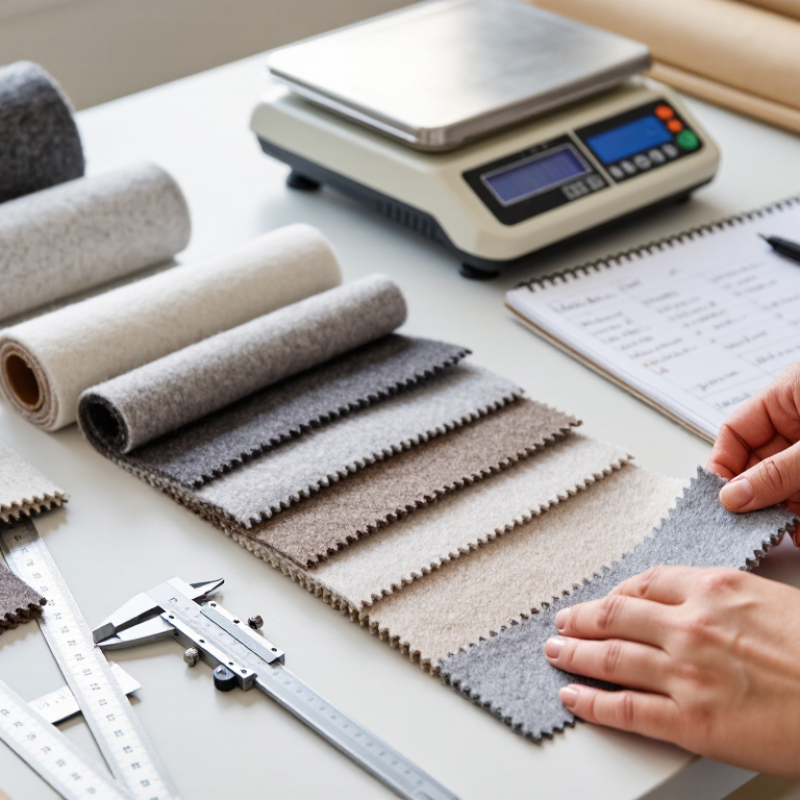
In my sourcing work, I never approve wool blend felt from photographs alone. Request samples from the actual production line, not only a showroom piece. Check the fiber ratio, thickness, density, color, and surface softness. A 3 mm sample can feel firm, while another 3 mm sample compresses easily. Measure it with a caliper. Touch it twice. Review the edge after cutting, because loose fibers often appear there first. Test shrinkage after washing or steaming if your product may face moisture. Also inspect odor, color consistency, and abrasion resistance under practical conditions.

Customization should be written into the quotation. Confirm the wool and synthetic fiber percentages, available colors, sheet or roll dimensions, backing options, and cutting tolerances. Ask whether custom colors require a physical standard. Digital color images can mislead under different lighting. Small details matter. Discuss packaging, labeling, pallet limits, and protection against dust or moisture. If special cutting or bonding is needed, request a production sample before placing a large order.

Order requirements deserve equal attention. Clarify the minimum order quantity, sample charges, lead time, payment stages, inspection method, and shipping documents. Record every approved specification in one file. Do not rely on chat messages alone. Production may vary slightly between batches, and I have underestimated this risk before. Set acceptable tolerances for thickness, color, and dimensions. Keep a retained sample for future comparisons, especially when repeat orders will come months later.

5 Tips for Buying Wool Blend Felt from Global Suppliers? - Checking Samples, Customization Options, and Order Requirements
No. Buying Tip Key Data Dimension Practical Reference What to Request Warning Sign
01 Check the fiber composition Wool percentage, secondary fiber type, and fiber declaration Compare the stated blend, such as 30%–80% wool with polyester, rayon, acrylic, or other fibers. The exact ratio affects warmth, handle, price, shrinkage, and durability. Fiber-content specification, test report when required, and a signed pre-production sample approval Composition is described only as “wool-like” or “premium blend” without percentages
02 Evaluate samples before ordering Thickness, density, surface uniformity, color, odor, and dimensional stability Common craft and industrial felt thicknesses include approximately 1–5 mm. Confirm actual thickness and weight across several points because felt can vary within a sheet or roll. A representative sample, measurement method, approved color swatch, and sample-retention reference The sample is unusually small, hand-selected, or not made with the proposed production material
03 Compare customization options Color matching, thickness, density, sheet or roll format, edge finish, and die-cutting Custom colors commonly require a minimum quantity and color approval. Die-cut parts require a drawing or dimensioned file, while roll goods require width, length, and winding direction. Customization matrix, color tolerance, cutting tolerance, tooling cost, setup fee, and approval procedure Custom features are promised verbally without drawings, tolerances, or approval samples
04 Clarify order requirements and total cost MOQ, price basis, packaging, lead time, payment terms, and shipping terms Minimum order quantities vary widely by color, thickness, format, and customization. Request pricing by square meter, linear meter, kilogram, or finished piece and compare the same unit. Written quotation, production lead time, sample charge, tooling charge, packaging details, and clearly defined delivery terms A low unit price excludes freight, tooling, inspection, packaging, duties, or other landed costs
05 Set quality and compliance requirements Shrinkage, colorfastness, pilling, flammability, restricted substances, and inspection criteria Requirements depend on end use. Decorative products may prioritize appearance, while apparel, interiors, toys, and technical products may need additional safety or chemical testing. Product specification sheet, applicable test reports, acceptable quality limits, inspection checklist, and corrective-action procedure Compliance documents are undated, unrelated to the material, or cannot be matched to the ordered specification
Buyer’s record: Keep the approved sample, specification sheet, quotation, test documents, and inspection criteria together so production shipments can be compared against the same reference.

Calculating Costs, Shipping Terms, and Supplier Reliability

5 Tips for Buying Wool Blend Felt from Global Suppliers

Start with total landed cost, not the quoted meter price. Add fiber content, density, cutting waste, inspection fees, insurance, duties, and inland delivery. Textile Exchange’s 2024 Materials Market Report places wool at about 1% of global fiber production, so specialized blends may carry limited-volume premiums. Request a cost sheet with currency, validity period, minimum order quantity, and sample charges. Small omissions become expensive.

Choose shipping terms that match your experience. Under FOB, you manage the main freight and many risks after loading. Under DAP, the supplier arranges delivery, but import taxes usually remain yours. Confirm the named destination and transfer point in writing. UNCTAD’s Review of Maritime Transport reports that maritime shipping carries over 80% of world trade by volume. Congestion still changes schedules and freight prices. Ask for two freight options and a realistic buffer.

Reliability needs evidence, not friendly emails. Request recent test reports for thickness, colorfastness, pilling, and fiber composition. Compare the report date with the production batch. A pre-shipment inspection can check rolls, labels, moisture, and packaging before release. The World Bank’s 2023 Logistics Performance Index emphasizes customs, infrastructure, shipment pricing, and tracking as key logistics factors. Check each area with references and tracking records. Forecasts are imperfect. Even experienced buyers miss seasonal delays. Keep a backup supplier, approve a sealed reference sample, and record acceptable tolerances before placing the order.

Request a Quote

To learn more about any of the products and services provided by Abbott Ball Company, Inc., simply complete the form below.