China Top 10 Plastic Ball Bearings Manufacturers examines a specialized supply market shaped by corrosion resistance, low friction, and lightweight design. Plastic ball bearings appear in food-processing equipment, medical devices, packaging lines, laboratory instruments, and small automation systems. Their performance depends on polymer selection, cage geometry, lubricant compatibility, temperature range, and dimensional control. Small parts matter.
Industry reports provide useful context. Fortune Business Insights valued the global bearings market at approximately USD 132.7 billion in 2023, with continued growth expected through 2032. This figure covers steel and non-metallic bearings, not plastic products alone. Grand View Research also identifies industrial automation, medical equipment, and material-handling systems as important demand areas for engineered polymer components. These reports support the market direction, but they do not independently rank Chinese manufacturers.
This guide therefore considers practical evidence, including product range, material options, load ratings, tolerance control, quality certifications, export experience, and technical support. It also reviews whether suppliers can provide PEEK, PTFE, POM, nylon, or reinforced polymer solutions for demanding applications. ISO 9001 systems, RoHS documentation, REACH compliance, and traceable inspection records can strengthen purchasing confidence. However, catalog claims require verification. A polished website is not enough. Buyers should request samples, test reports, dimensional data, and references for similar operating conditions. Manufacturing capability may vary between factories, even within the same group. That limitation deserves attention. This ranking is intended as a research starting point, not a substitute for engineering validation or supplier audits.
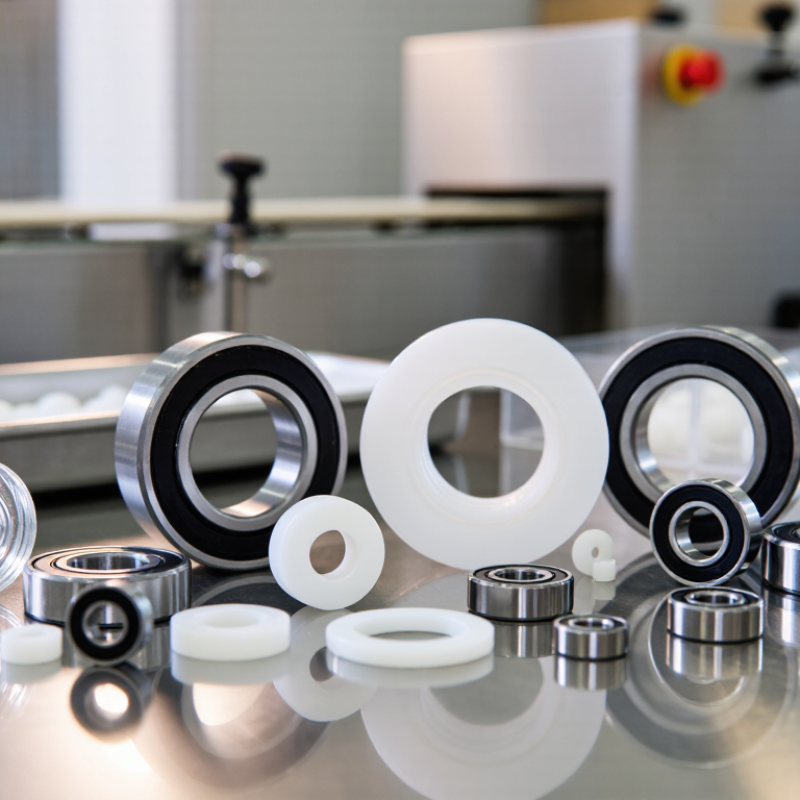
China Top 10 Plastic Ball Bearings Manufacturers
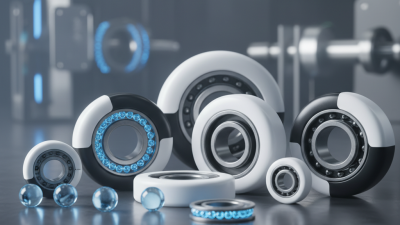
Plastic ball bearings are low-friction components with polymer races, retainers, and rolling balls. They guide shafts while reducing contact resistance, noise, and maintenance needs. Unlike steel bearings, many plastic designs operate without routine lubrication. Their low density also reduces moving mass, which helps compact conveyors, laboratory equipment, and light automation systems. Quiet motion matters.
A 2024 Fortune Business Insights report valued the global ball bearing market at about USD 19.34 billion in 2023. It projects approximately USD 28.70 billion by 2032. This growth reflects demand for reliable motion-control parts, but the report does not isolate plastic bearings. That limitation matters. Market numbers can look more exact than they really are.
In practical selection, engineers compare load, speed, temperature, moisture, and chemical exposure. Polymer bearings often resist corrosion, yet some soften under heat or deform under sustained loads. Glass or ceramic balls can improve electrical insulation and running smoothness. Still, performance depends heavily on clearance and shaft alignment. A bearing may pass a catalog test and fail in a dusty, misaligned machine. Testing under real operating conditions remains essential. Sometimes, the “maintenance-free” label needs more questioning.

China’s plastic ball bearing sector relies on engineering polymers selected for specific working conditions.
PTFE offers low friction and chemical resistance, while PEEK tolerates higher temperatures and repeated loads. Nylon is economical and performs well in moderate environments. UHMW-PE suits applications needing impact resistance and quiet movement. Balls may use glass, ceramic, or stainless steel, depending on speed, corrosion exposure, and electrical requirements.
Manufacturing quality depends on more than material selection. Injection molding creates consistent races and cages, but shrinkage can still affect clearance. Precision CNC machining corrects critical dimensions, especially in small production batches. Experienced factories often combine automated assembly with optical inspection, torque testing, and load testing. Batch records and material certificates improve traceability. I have found that surface finish is sometimes discussed less than hardness, although it strongly influences noise and wear. That deserves more attention.
Tips: Confirm temperature, load, chemical contact, and shaft tolerance before ordering. Request test data, not only catalog values. Check whether the stated load rating applies to continuous use. A cheaper polymer is not always the better choice. Also, ask how manufacturers control molding warpage and inspect internal surfaces. Small defects can remain invisible but cause early failure.
China Top 10 Plastic Ball Bearings Manufacturers
Selection Criteria for the Top 10 Manufacturers
Selecting leading plastic ball bearing manufacturers requires more than comparing catalog prices. Real performance begins with material control. We examine whether suppliers identify polymer grades, reinforcement types, and temperature limits clearly. The bearing should match the shaft, load, speed, moisture, and cleaning conditions. Small details matter.
Production experience is another practical measure. A reliable factory can explain molding controls, dimensional tolerances, cage design, and lubrication choices. We look for documented inspections at incoming, in-process, and final stages. Sample testing should include noise, rotation resistance, wear, and dimensional stability. Clear test records carry more weight than polished sales language.
Traceability builds confidence. Manufacturers should link batches to raw materials, operators, inspection results, and shipment records. They should also provide accurate technical drawings and support reasonable compliance requirements for the target market. Communication matters during sampling, especially when a bearing fails under heat or repeated washing. Slow answers may reveal weak engineering support.
No ranking is permanent. A supplier may perform well on samples but struggle during larger production runs. That possibility deserves attention. Independent audits, reference projects, and repeat testing can expose gaps. I would also question unusually low prices, because savings may hide inconsistent resin, loose tolerances, or limited quality checks. The strongest candidates combine measurable process control with honest responses when something goes wrong.
| Rank | Evaluation Dimension | Weight | Objective Selection Standard | Recommended Evidence | Why It Matters for Plastic Ball Bearings |
|---|---|---|---|---|---|
| 01 | Material Capability | 18% | Demonstrated processing of engineering thermoplastics such as POM, PA, PTFE, and PEEK, with material grades documented for each application. | Material datasheets, certificates of analysis, resin traceability, and molding-process records. | Material choice affects friction, wear resistance, moisture absorption, chemical resistance, and operating temperature. |
| 02 | Dimensional Accuracy | 15% | Uses controlled molding, post-molding inspection, and documented tolerances for bore, outside diameter, width, and roundness. | Inspection plans, calibrated measuring equipment, capability studies, and sample inspection reports. | Accurate geometry supports smooth rotation, correct fit, reduced vibration, and predictable service life. |
| 03 | Load and Speed Testing | 14% | Provides application-specific testing for radial load, axial load, rotational speed, friction torque, and wear rather than relying only on catalog values. | Test methods, load-speed curves, endurance data, torque measurements, and failure analysis. | Plastic bearings are sensitive to temperature, lubrication conditions, load, speed, and mating-shaft design. |
| 04 | Quality Management | 12% | Maintains a documented quality system, preferably certified to ISO 9001 or an equivalent internationally recognized standard. | Valid certificate, internal audit records, corrective-action reports, and batch-level quality records. | A controlled system reduces variation in molded parts and improves corrective-action traceability. |
| 05 | Application Engineering | 10% | Can review shaft hardness, surface finish, clearance, misalignment, temperature, chemical exposure, and lubrication requirements. | Technical drawings, tolerance recommendations, engineering calculations, and design-review records. | Correct system design is essential because bearing performance depends on the complete shaft-and-housing assembly. |
| 06 | Production Capacity | 8% | Offers stable capacity for both standard parts and repeat custom orders, with documented mold maintenance and production planning. | Capacity statements, lead-time history, production schedules, and mold-maintenance records. | Stable capacity helps prevent delivery interruptions and maintains consistency between production batches. |
| 07 | Compliance and Safety | 8% | Supports applicable requirements such as RoHS and REACH; food-contact or medical applications require additional sector-specific documentation. | Declarations of conformity, restricted-substance reports, safety datasheets, and application-specific compliance documents. | Compliance evidence reduces regulatory and supply-chain risks for export applications. |
| 08 | Customization Capability | 6% | Provides custom dimensions, flange or groove options, cage designs, material combinations, and prototype support when technically justified. | Engineering-change procedures, prototype samples, tooling quotations, and approval drawings. | Non-standard designs may be required for restricted spaces, unusual loads, or special environmental conditions. |
| 09 | Delivery and Packaging | 5% | Maintains practical lead times, protective packaging, lot identification, and export documentation appropriate for precision molded components. | On-time delivery records, packaging specifications, carton labels, and inspection release documents. | Protection against deformation, contamination, and mixed lots is important during storage and international transport. |
| 10 | Total Cost and Service | 4% | Evaluates total cost of ownership, including tooling, unit price, inspection, logistics, warranty handling, and technical support—not price alone. | Comparable quotations, warranty terms, response-time records, and lifecycle-cost calculations. | A lower purchase price may not offset premature wear, frequent replacement, downtime, or engineering changes. |
| Total Evaluation Weight | 100% | Use documented evidence and application-specific testing to compare qualified manufacturers without relying on brand claims alone. | |||
China’s Top 10 Plastic Ball Bearings Manufacturers
China’s leading plastic ball bearing manufacturers serve medical equipment, food-processing lines, packaging machines, and laboratory instruments. Their profiles differ in materials, production scale, and quality-control depth. Profile One focuses on miniature bearings for quiet laboratory devices. Profile Two produces corrosion-resistant units for humid production rooms. Profile Three specializes in custom dimensions and short development cycles. Profile Four supplies lightweight bearings for conveyor systems. These factories typically inspect raceway surfaces, measure radial clearance, and test rotation noise. Small details matter.
Profile Five develops engineering-plastic cages for continuous movement. Profile Six emphasizes non-lubricated bearings for cleaner operating environments. Profile Seven works with ceramic balls to reduce friction and electrical conductivity. Profile Eight offers reinforced designs for moderate loads and repeated washing. Profile Nine supports export orders with technical drawings, material certificates, and sample inspections. Profile Ten combines standard sizes with private tooling services. Its strength is flexibility, not unlimited capacity.
Reliable evaluation requires more than a polished catalog. Buyers should review resin grades, temperature limits, load calculations, and documented inspection methods. Factory visits can reveal storage conditions, measurement equipment, and worker training. A bearing may look precise yet fail after heat exposure or chemical contact. No manufacturer is perfect. Some factories have excellent machining but slower communication. Others respond quickly but need stronger test documentation. Trial orders remain wise, especially when noise, clearance, or sterilization affects the application.
When comparing China’s top ten plastic ball bearing manufacturers, application fit matters more than catalog variety. These bearings serve conveyors, packaging lines, laboratory equipment, water systems, and light medical machinery. Food-contact applications require careful material and hygiene review. Chemical exposure also changes the choice. POM suits general motion, while PTFE and PEEK handle more demanding environments. Glass, ceramic, or stainless steel balls affect weight, corrosion resistance, and operating noise.
Quality checks should include dimensional reports, running tests, load data, and material traceability. Buyers often request evidence of ISO 9001 quality systems, plus RoHS and REACH declarations where relevant. These documents support reliability, but they do not replace application testing.
Confirm clearance, shaft tolerance, temperature range, speed, and lubrication conditions. A bearing may perform well in a dry test yet fail early under dust, moisture, or continuous vibration. Small details matter.
Market decisions involve minimum order quantity, tooling fees, samples, packaging, export records, and replacement support. Standard sizes usually shorten lead times and reduce development costs. Custom designs may improve performance, but they can create long approval cycles. A low quotation is tempting. It may hide inconsistent inspection or limited after-sales communication. No supplier gets every point right, so buyers should compare test evidence, response quality, and total operating cost instead of price alone.
To learn more about any of the products and services provided by Abbott Ball Company, Inc., simply complete the form below.